How EVA Footwear Is Manufactured: From Raw Material to Finished Product
A finished pair of slippers or sliders may look simple, but creating consistent footwear involves several coordinated manufacturing activities. Material preparation, tooling, moulding, finishing and inspection all play a role in the final product.
For footwear brands and manufacturing partners, understanding this process provides useful insight into how design concepts become finished products ready for distribution.
APL Footwear, a brand of Alpine Poly Rub Pvt. Ltd., has documented manufacturing capabilities covering EVA compounding, injection moulding, die-cutting, DIP processes, finishing and dispatch. The precise route depends on the product type and its construction.
1. Product design and development
The process begins with defining the intended footwear design.
The product team considers factors such as:
- Target consumer and intended use
- Shape, dimensions and available sizes
- Strap, upper and sole construction
- Colour and surface finish
- Material requirements
- Tooling and production feasibility
A successful design must be visually appealing while remaining practical to manufacture. Design and technical teams work together to translate product requirements into specifications that can guide tooling and production.
2. Material selection and preparation
The choice of material influences the characteristics of the finished footwear.
EVA is commonly used in lightweight footwear applications. Depending on the intended product, manufacturers must consider the material formulation, processing requirements, colour and desired physical characteristics.
Material preparation may involve controlled mixing or compounding, depending on the manufacturing method.
The objective is to prepare material suitable for the intended process and product requirements. Specific formulations and operating conditions should be determined by the manufacturer’s technical team rather than assumed to be identical for every style.
3. Moulding and forming
Moulding helps transform prepared material into the required footwear shape.
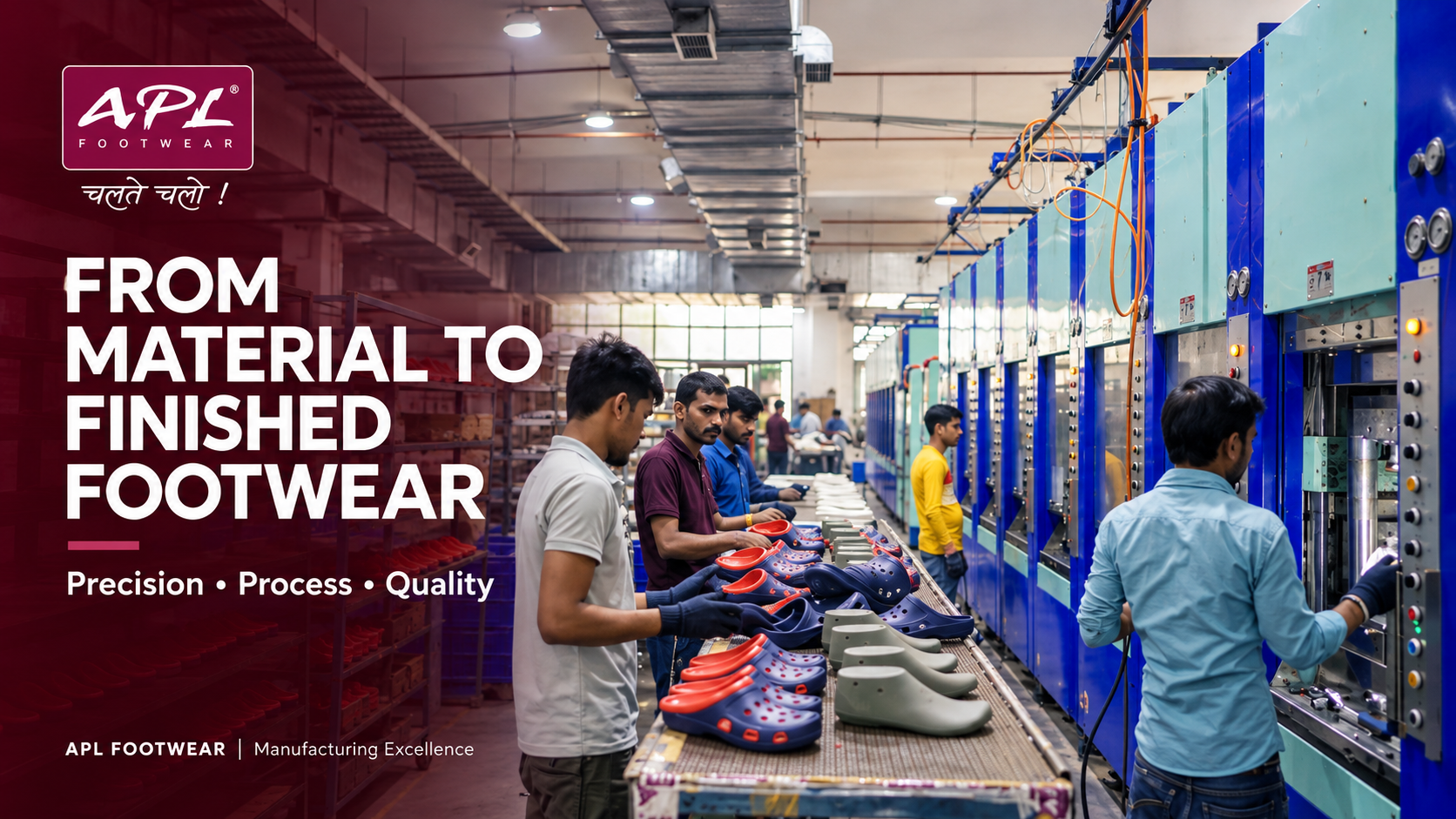
For injection-moulded products, suitable material is processed using machinery and moulds designed for the product. The mould defines important features such as the sole profile, surface details and overall geometry.
Tooling accuracy and maintenance are important because the mould directly influences the consistency of the manufactured component.
Different footwear designs require different tooling and process settings. A flip-flop, slider and clog, for example, may require different mould designs and production considerations.
4. Die-cutting and other production methods
Not all footwear follows the same manufacturing route.
Depending on the product, production may involve die-cutting, injection moulding, DIP and injection-moulded processes, or a combination of appropriate operations.
Die-cutting is used to produce components in specified shapes from suitable sheet or material formats. Injection moulding forms components through a moulding process, while DIP processes are used for product constructions designed for that method.
The selected route depends on the footwear’s construction, materials, tooling and technical requirements.
5. Finishing and assembly
After forming, products may require additional finishing operations.
These can include trimming, component assembly, strap fitting, marking, stitching or other operations relevant to the particular design.
Not every operation applies to every product. The purpose of finishing is to bring the product to its intended final form and address any visible or functional issues identified during the process.
Good process coordination helps manufacturers manage product consistency across different styles and production batches.
6. Quality inspection and physical testing
Quality should be considered throughout production rather than only at the end.
Depending on the product and applicable specifications, quality activities may include:
- Visual inspection for surface defects
- Dimensional checks
- Verification of colour and component consistency
- Assessment of relevant physical properties
- Inspection of assembly and finishing
- Review against approved product requirements
APL’s supplied company materials describe a chemical laboratory for compound testing and a physical testing laboratory. The specific tests performed, standards followed and acceptance criteria should be confirmed by the technical team before they are described in detail on the website.
A professional quality process relies on documented requirements and suitable testing methods, not broad claims alone.
7. Packaging and dispatch
Once finished products have passed the required checks, they are prepared for packing and distribution.
Packaging operations help protect products, organise orders and support their movement through the supply chain. Identification and scanning systems may also support tracking and warehouse coordination where implemented.
Accurate product identification, order preparation and dispatch processes are particularly important when managing multiple designs, sizes and colourways.
Why manufacturing capability matters to footwear buyers
For retailers, distributors and business partners, a manufacturer’s capabilities can affect several aspects of a commercial relationship.
Product range: The ability to support different styles and constructions can provide more choice when planning a catalogue.
Consistency: Appropriate tooling, process control and inspection help support repeatable product requirements.
Production coordination: Well-organised workflows help connect manufacturing, finishing, packing and dispatch.
Development opportunities: A clear technical process can support discussions about new designs and product requirements.
Actual capabilities, lead times, capacity and quality standards should always be confirmed for the specific product and order.
APL Footwear’s manufacturing approach
APL Footwear’s available company materials describe production capabilities spanning EVA compounding, injection moulding, die-cutting, DIP footwear, tooling and mould maintenance, finishing and testing, and packaging and dispatch.
The company’s manufacturing story is best communicated through real facility photographs, process explanations and approved technical information.
For business visitors, this information can help explain how different manufacturing activities contribute to the finished footwear range.
Frequently asked questions
What are the main stages of EVA footwear manufacturing?
Depending on the product, the stages can include design, material preparation, moulding or forming, finishing, inspection, packaging and dispatch.
Does every footwear product use the same process?
No. Manufacturing methods vary according to material, product construction, tooling and design requirements.
Why is mould maintenance important?
Mould condition can influence product shape, surface detail and consistency. Appropriate maintenance helps keep tooling suitable for production.
Why is quality inspection necessary?
Inspection helps identify whether products meet the defined specifications and applicable quality requirements.
Conclusion
Footwear manufacturing is a coordinated process that brings together product design, material knowledge, machinery, tooling, finishing and inspection.
Understanding these stages helps buyers appreciate the work behind a finished product and gives business partners a clearer basis for discussing product requirements with manufacturers.
APL Footwear’s manufacturing capabilities form an important part of its company story. Explore the manufacturing page to learn more about its documented production processes and infrastructure.